Well I guess the 'roids are working (thyroid, that is). I'm officially doping. I can't believe how much better I've been feeling these past few weeks. I got a trim yesterday, and the stylist couldn't believe how much my hair had grown since the last time I'd seen him. He thought it was freakish. I take it as a good sign.
Monday was a day off. I was so sore from climbing the mountain and the dreadful 12 mile Penasquitos Canyon run Sunday, plus the snorkeling with the leopard sharks off La Jolla Shores in crazy, white-cap, choppy water.
Tuesday, we did our first club track workout. It was AWESOME. I was so sore afterwards though. It didn't help that I was sore when I started too. My legs felt like jello. We did a warm-up mile easy. 1 lap of "strides" which I later learned was just a quick, acclerating pace where you sprint on the long sides and shorten on the short sides. Then, we paired up and did a "baton" relay. We each ran 1 lap with the baton while the other partner rested before handing off the baton and letting our partner go. We did this 4x each before switching partners and repeating for a total of 3 sets (12x or 3 miles). It was great! I nearly died the 3rd lap, right off the bat, but felt stronger and stronger as I kept going. I was able to cut time off and then maintain it (fastest 1:15, avg 1:30, slowest 2:00). I guess all that base training really helped. Plus, it was a great way to meet people.
Wednesday, I did my own thing. A great free-weight session followed by a solid tempo ride on the trainer while watching re-runs of Lost. It's my first time. My sister got me into it. It's actually quite a captivating show they got going on.
Thursday, I eeked in a quick pool swim at the gym next to where I work. It's a cute, little gym that I recently "discovered." It's very well hidden and small so not a lot of people use it. I like having a whole pool to myself, even if it is only 4 lanes and 25 yards instead of meters. I did sprints followed by a solid 500m "endurance" set. I love sprints (well, okay--100m, not 200s, 200s suck)! They make me feel fast, even if I do want to puke by the end.
Friday, I snuck in a 4 mile run before rushing off to the cove for a swim with the tri club. Not a lot of people showed up. I guess the whole fall, less daylight, colder water, end-of-the-season, school-has-started thing. I went in anyway. FREEZING! It was 70 on Sunday (snuggly) and 60 today (ack!). Plus, the swells were huge. I swam out with a group to the first 1/4 mile buoy. Then, everyone else went back in b/c it was too cold and choppy. Wusses. I felt good at this point. Afterall, I was wearing my suit of armor er, wetsuit. So I kept going. Made it to the 3rd buoy. Swam towards the Shores a bit before turning back.
I always feel like going back is harder than going out. It was getting dark, and at this point, I realized I was all alone. Out there all by myself, in the middle of the great big ocean, with lots of waves. Ugh. I just kept swimming at this point. The whole swimming-in-the-ocean-in-the-dark thing still really freaks me out. I conjure "things" in my head and they "appear." A dark shape beneath. What was that!? The play of shadows on a wave next to me....was that another swimmer? Hey! I'm not alone! Wait...Was it....a creature?! AAAAAAHHH! Oh, it was nothing. Okay. I focused on the houses above the cliffs, and focused on slowing my breathing and taking long, slow strokes. I made it back, unscathed (and un-seasick!).
Tomorrow--we have our last long run planned before the big half-marathon next week.
And Sunday--we're biking the Tour de Poway. A hilly 44 mile ride. Yippee!
Somehow, all this activity, and it never feels like enough. Ack. I'm so sore....I like it that way.
Friday, September 29, 2006


Wednesday, September 27, 2006
Per Request--Bike Porn

By popular demand, I have provided the following pics demonstrating how I've pimped my bike. Enjoy...
1. new clip-on aerobars (specially fitted to the bike with me on it)
2. Compact cranks to replace the triple ring (so no more knee pain b/c the angle from my hip to knee is straighter; yay!)

 3. The whole kit and kaboodle. Isn't she sweet?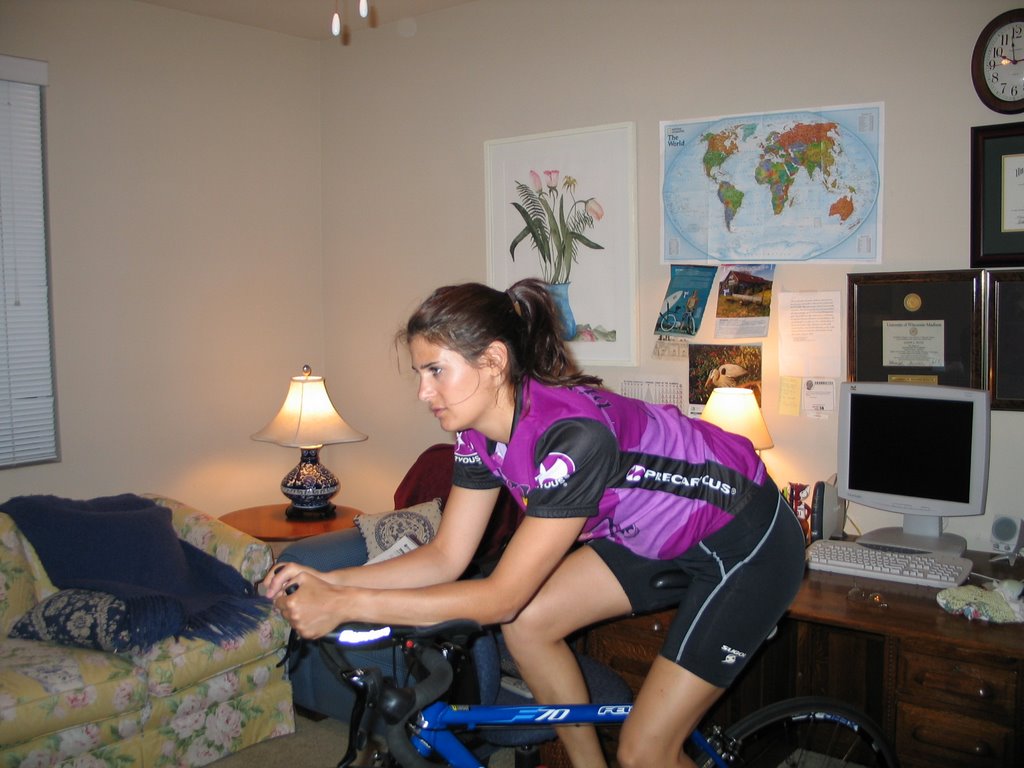
4. Modeling the bike in the new-and-improved aero position, of course.
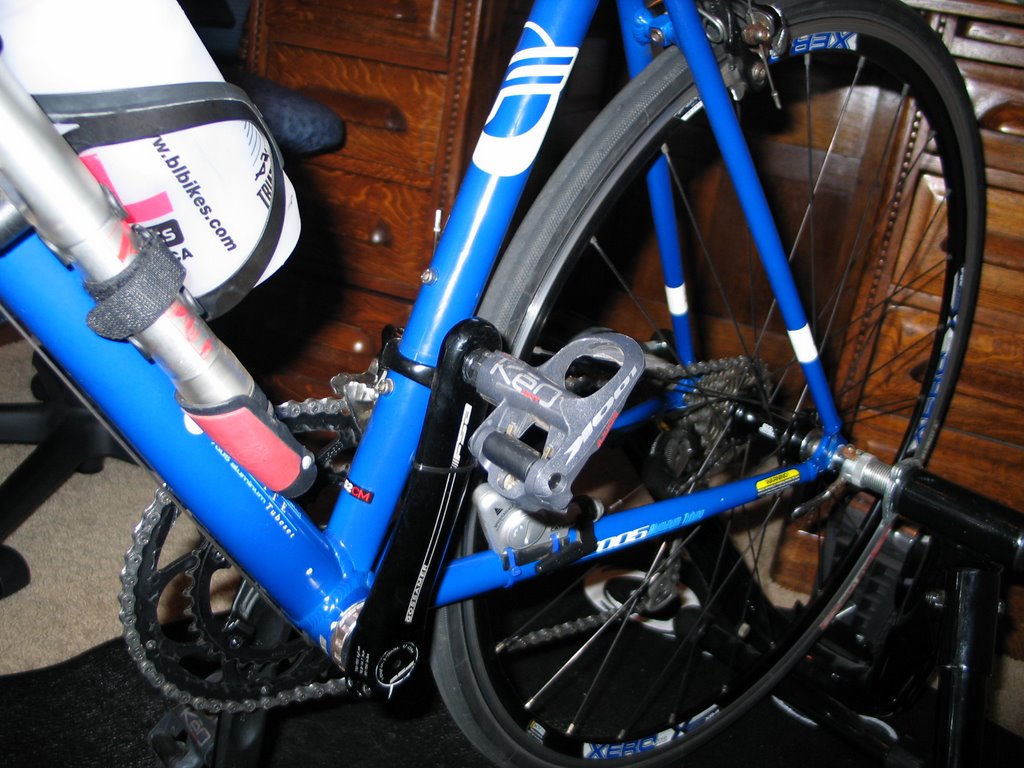
5. Last, but not least, upgraded Look pedals. Very zippy.
Tuesday, September 26, 2006
Busy, busy--catch up on recent events
I can't believe how busy I've been and how long it's been since I've had a chance to catch up.
The aerobars are great. Pics are coming soon. The aerobars were fitted to my bike (while I was on it) at a great local bike shop so I'm able to use it as a road bike and also enjoy the aero position at the same time. In addition, I upgraded my clipless pedals (Look) and swapped out my triple chain ring for compact cranks. I also got the whole thing tuned up, including cleaning, lube, new brake pads, and a new chain. I got new race tires a few months ago. Can we say pimped out? It's awesome. I'm lovin' it.
The thyroid medication has been working. I've leaped back into workouts at full throttle. Part of me wants to get back into shape (and lose the muffin top I've gained), and the other part (the main part), is just having a blast. I logged in 11 hours the week before and 8 hours last week, which is more than I've done all year! It seems like a lot but it feels right. I'm eating better, sleeping better, and sticking to a routine more consistently.
Last week, Tammy from Seattle visited and joined us for an ocean swim at La Jolla Shores. It was such a pleasure to meet another fellow blogger! I can't wait to do it again. My sister, Erin from UC Davis, visited for a long weekend last week, and we had a blast. The two of us went snorkeling at the Shores and saw tons of leopard sharks (harmless). It was awesome. They flock here to breed every fall. We were surrounded by them (up to 7-8 at a time), and they were very docile. Each one had slightly different leopard spots, colors, and patterns. Some of them were huge (~7 feet long)! The surf was really rough though, and we were buffeted about pretty badly. Thank God for buoyant wetsuits! I've never seen it that choppy off the Shores. We could see whitecaps all the way out to sea.
Saturday, Jason and I participated in the tri club's Pine Valley Duathlon. Basically, we drove up to this little town east of San Diego at 4000 feet and then biked up this mountain. We biked 17 miles up to Mt. Laguna in the Cleveland National Forest, reaching 6000 feet.
I know this doesn't sound like much for most of you who don't live at sea level but, believe me, my lungs felt it. Big time. Imagine biking straight up a mountain on windy switchback roads with no shoulder and a cliff to the right of you with speedy little sports cars doing their weekend joy rides to the left of you. Oh, and add hurricane-like gusts of wind coming down the mountain and sudden gusts coming at you from the sides, making a deafening squealing sound for the first 8 miles. It was like biking up a mountain in a wind tunnel.
It sounds like I'm exaggerating. Like I'm an old granddaddy telling his grandkids they have it easy, and when he was a kid, he had to walk uphill through the snow to school for 5 miles--both ways. And he had to eat nails for lunch. And he liked it! No, but seriously, that's what's so incredible. It's not an exaggeration. It was crazy. My upper body was sore from gripping the handlebars like grim death to keep the bike upright. I was scared, no terrified, a few times that I was going to be blown over.
And then my lungs started screaming. And my throat was burning. The air was so thin and dry, and the wind was bone-chilling. My eyes were watering and my nose was running, and my head was pounding from the lack of oxygen. A few times, the grade was so steep, I had a hard time turning the pedals over. 6 mph, the whole way up, in my lowest gear. We were afraid to stop because if we did, we weren't sure we could get enough momentum to get going again.
But then it started leveling off, and we realized we could clearly see the Anza-Borreogo Desert below us (a lot of dirt), and we were surrounded by pine trees and cows. I also saw a few turkey vultures, struggling to fly through the wind. I was just hoping they weren't waiting for us to keel over. At the top, the club had arranged a kick-ass picnic with chicken fajitas, sweet strawberries, all sorts of soda, Gatorade, fruit juice, and muffins, brownies, etc. Good thing too, because I had been hallucinating waffles and bacon just a few miles back. Giddy with the feeling of accomplishment for making it up the mountain (and lack of oxygen), we ate and chatted (I, on very wobbly legs).
Then, we turned around and biked back down. It was awesome. Like a well-earned treat. I didn't pedal for 10 miles. No, I had to use my brand-spankin' new brake pads. I had to brake to 40 mph. I just didn't feel comfortable flying around the switchbacks (no shoulder) at a faster pace. It was exhilarating and terrifying at the same time.
My legs, needless to say, were toast. Jason and I, stupidy, tried to do a 12 mile run in the Penasquitos Canyon on Sunday but we ended up walking a lot. It was hot, dusty, and my legs were very mad at me.
Earlier this week (Thursday), I did the club Aquathlon at the Shores (1000 meter swim/3 mile run), which was great. I passed a guy at the end who wasn't too happy about it, and he rallied with me almost to the end (don't worry; I kicked his butt).
Last weekend, I also had the chance to try out my new aerobars, which I love. I feel stronger and more efficient in them. I feel like I can go forever. It's amazing. I ended up going 37 miles and had only planned on going 20. Note to self: do not add Gu to your water unless you don't want to drink the rest of the way home. Bleck! It was very scenic--gorgeous horses that made my heart ache, hot air ballons, hanggliders, surfers, the ocean, pelicans swooping down the coast for the evening dinner patrol, a gorgeous sunset--doesn't get much better than that.
The aerobars are great. Pics are coming soon. The aerobars were fitted to my bike (while I was on it) at a great local bike shop so I'm able to use it as a road bike and also enjoy the aero position at the same time. In addition, I upgraded my clipless pedals (Look) and swapped out my triple chain ring for compact cranks. I also got the whole thing tuned up, including cleaning, lube, new brake pads, and a new chain. I got new race tires a few months ago. Can we say pimped out? It's awesome. I'm lovin' it.
The thyroid medication has been working. I've leaped back into workouts at full throttle. Part of me wants to get back into shape (and lose the muffin top I've gained), and the other part (the main part), is just having a blast. I logged in 11 hours the week before and 8 hours last week, which is more than I've done all year! It seems like a lot but it feels right. I'm eating better, sleeping better, and sticking to a routine more consistently.
Last week, Tammy from Seattle visited and joined us for an ocean swim at La Jolla Shores. It was such a pleasure to meet another fellow blogger! I can't wait to do it again. My sister, Erin from UC Davis, visited for a long weekend last week, and we had a blast. The two of us went snorkeling at the Shores and saw tons of leopard sharks (harmless). It was awesome. They flock here to breed every fall. We were surrounded by them (up to 7-8 at a time), and they were very docile. Each one had slightly different leopard spots, colors, and patterns. Some of them were huge (~7 feet long)! The surf was really rough though, and we were buffeted about pretty badly. Thank God for buoyant wetsuits! I've never seen it that choppy off the Shores. We could see whitecaps all the way out to sea.
Saturday, Jason and I participated in the tri club's Pine Valley Duathlon. Basically, we drove up to this little town east of San Diego at 4000 feet and then biked up this mountain. We biked 17 miles up to Mt. Laguna in the Cleveland National Forest, reaching 6000 feet.
I know this doesn't sound like much for most of you who don't live at sea level but, believe me, my lungs felt it. Big time. Imagine biking straight up a mountain on windy switchback roads with no shoulder and a cliff to the right of you with speedy little sports cars doing their weekend joy rides to the left of you. Oh, and add hurricane-like gusts of wind coming down the mountain and sudden gusts coming at you from the sides, making a deafening squealing sound for the first 8 miles. It was like biking up a mountain in a wind tunnel.
It sounds like I'm exaggerating. Like I'm an old granddaddy telling his grandkids they have it easy, and when he was a kid, he had to walk uphill through the snow to school for 5 miles--both ways. And he had to eat nails for lunch. And he liked it! No, but seriously, that's what's so incredible. It's not an exaggeration. It was crazy. My upper body was sore from gripping the handlebars like grim death to keep the bike upright. I was scared, no terrified, a few times that I was going to be blown over.
And then my lungs started screaming. And my throat was burning. The air was so thin and dry, and the wind was bone-chilling. My eyes were watering and my nose was running, and my head was pounding from the lack of oxygen. A few times, the grade was so steep, I had a hard time turning the pedals over. 6 mph, the whole way up, in my lowest gear. We were afraid to stop because if we did, we weren't sure we could get enough momentum to get going again.
But then it started leveling off, and we realized we could clearly see the Anza-Borreogo Desert below us (a lot of dirt), and we were surrounded by pine trees and cows. I also saw a few turkey vultures, struggling to fly through the wind. I was just hoping they weren't waiting for us to keel over. At the top, the club had arranged a kick-ass picnic with chicken fajitas, sweet strawberries, all sorts of soda, Gatorade, fruit juice, and muffins, brownies, etc. Good thing too, because I had been hallucinating waffles and bacon just a few miles back. Giddy with the feeling of accomplishment for making it up the mountain (and lack of oxygen), we ate and chatted (I, on very wobbly legs).
Then, we turned around and biked back down. It was awesome. Like a well-earned treat. I didn't pedal for 10 miles. No, I had to use my brand-spankin' new brake pads. I had to brake to 40 mph. I just didn't feel comfortable flying around the switchbacks (no shoulder) at a faster pace. It was exhilarating and terrifying at the same time.
My legs, needless to say, were toast. Jason and I, stupidy, tried to do a 12 mile run in the Penasquitos Canyon on Sunday but we ended up walking a lot. It was hot, dusty, and my legs were very mad at me.
Earlier this week (Thursday), I did the club Aquathlon at the Shores (1000 meter swim/3 mile run), which was great. I passed a guy at the end who wasn't too happy about it, and he rallied with me almost to the end (don't worry; I kicked his butt).
Last weekend, I also had the chance to try out my new aerobars, which I love. I feel stronger and more efficient in them. I feel like I can go forever. It's amazing. I ended up going 37 miles and had only planned on going 20. Note to self: do not add Gu to your water unless you don't want to drink the rest of the way home. Bleck! It was very scenic--gorgeous horses that made my heart ache, hot air ballons, hanggliders, surfers, the ocean, pelicans swooping down the coast for the evening dinner patrol, a gorgeous sunset--doesn't get much better than that.
Monday, September 18, 2006
Thursday, September 14, 2006
Triathlon and the Drill Seargent
There was an article in September's issue of Triathlete magazine titled, "The legend of Mr. Triathlon," that really struck a chord with me. In this article, the author describes trying to silence the perfectionist within and balance his competitive edge with being healthy and having fun. It's definitely easy to overdo it. Why else would we read so many articles on overtraining (and then write them off b/c they don't apply to us)?
There is a drill seargent that sits on my shoulder and shouts orders. I always feel compelled to obey, although I don't as much anymore (I have a couch potato on the other shoulder; some people have angels and devils; I have drill seargents and couch potatoes). He's always shouting, "Eat less! Work harder! Exercise more! Go farther, faster, harder! Be perfect!" Sometimes, I ignore him and am happy with what I can do. Other times, my drill seargent tears apart and tells me I'm no good.
I used to think I was alone in obsessing about the "perfect" body image, shape, and weight. That I was the only one in the gym for hours on end, ensuring I got my exercise in. Even though the AHA only recommended about 6 hours of physical activity a week (including gardening and cleaning), that didn't apply to me. No. That wasn't acceptable for me. I had to go above and beyond that.
I never actually had an eating disorder but I walked the line. I definitely had/have body image issues. Everyone has one body part they hate. My nemesis is my gut (on many levels b/c I also suffer from IBS). I can't stand the pooch that poofs out over my pants. I used to obsess about it (I still do to some extent). I wanted to have "Britney Spears abs" (before she had kids, obviously) and began doing several hundred sit-ups a day, upping the cardio, and counting calories.
Never mind that the actresses in Hollywood and models on the catwalks are unhealthy, all have eating disorders, and all have plastic surgery. Never mind that their bodies aren't naturally like that. I became obsessed with making my body conform to that image. And I'm a smart person. I know all about eating disorders, the media, the hype, that these bodies aren't "real." And I still tricked myself into this mindset. I love the recent news stories on the new restrictions on super-skinny runway models. (They won't be allowed to participate in fashion shows unless they have a B.M.I. of at least 18, which means the minimum weight for the average, 5'9" model is 120! Over 1/3 of them won't meet this requirement. Models with BMIs of 16 or below will receive medical intervention. The model agencies are arguing that this is discrimination against naturally thin people. Puh-lease! No one that eats well and is 5'9" or taller weighs 90 lbs!!!)http://www.timesonline.co.uk/article/0,,3-2349467,00.html
http://www.news.com.au/entertainment/story/0,23663,20393440-5007192,00.html
The majority of the country is overweight or obese (statistics from the NIH, based on BMI). http://win.niddk.nih.gov/statistics/index.htm
There are people who really do benefit from nutritionists, balanced but restricted diets, food journals, etc. And everyone should exercise and eat healthfully. But then there are others who really should eat more. I've never been able to be happy at my "healthy" weight. At 5'8", 130 lbs., I'm naturally lean. I should be happy. My BMI (body mass index, which is height in meters squared, divided by weight in kg) is 20, right there on the low side of healthy, according to the NIH (Normal is between 19 and 24).
(You can calculate your BMI at the following website: http://www.nhlbisupport.com/bmi/)
However, I still have this damn "pooch" that I find unacceptable. I think my low point was on a hot, humid run in St. Louis one brutal summer day. I was pushing my pace, like always, and felt awful. I felt naseous and sick. Jason told me to stop, and I refused. He asked why I wouldn't just take a walk break. My answer was, "Not unless I fall down, pass out, or throw up." Then I actually began wishing for one of those things to happen in order to justify slowing down.
A few months after dieting and spending hours upon hours at the gym, I began suffering from minor overuse injuries from running every day. I started mixing in swimming. Then came the bike. Triathlon followed shortly after. It seemed like fun. That's a good thing. Like a great way to apply all that fitness I had been building at the gym. It also seemed like a great way to legitimize the unhealthy mindset I had adopted. "Oh, I can't eat that b/c I'm in training. I have to exercise this much b/c I'm training."
In my first season of triathlon, my largest week load was 18, and I was averaging 15, enough for an Ironman. I was doing sprints. After completing a few races during my first season, I suffered from fatigue, overuse injuries, and was fast-approaching burn-out. I read an article about overtraining and realized my symptoms fit to a tee. I realized if I didn't cut back on training and rest more, I wouldn't be able to keep it up, and my performance would suffer.
A transition ensued. Instead of caring about body-image, I focused on performance. Triathlon began transforming the way I perceived myself. It wasn't about how I looked, it was about what I could do. I have become much better at listenign to my body and allowing myself to cut back and rest when I need it. But I'm not perfect (hmmm. new concept). I still err on doing too much and beat myself up for not doing more.
Focusing too much on performance can also trigger my drill seargent. It's like swapping one obsession for another. I admit, I walk a fine line. It's great to have a competitive edge and strive to be healthy and active. But, especially with triathlon, there's a fine line that I must walk on--to do enough, but not too much. It's not like a drug addiction, where you cut the drug out of your life forever. I hope to always eat a balanced diet and lead an active lifestyle. But I'm learning when to ignore the drill seargent and listen to my body and when the drill seargent might positively motivate me to push my limits and see how far I can go and what amazing goals I can achieve.
Time to go for a run. Nothing makes me feel more alive than my heart pounding in my chest and the sweat dripping down my chin. Good music in my ears and the rhythm of my feet pounding the dirt beneath me. The smell of the salt water from the ocean and the sight of pelicans flying overhead. It's all about keeping it fun.
There is a drill seargent that sits on my shoulder and shouts orders. I always feel compelled to obey, although I don't as much anymore (I have a couch potato on the other shoulder; some people have angels and devils; I have drill seargents and couch potatoes). He's always shouting, "Eat less! Work harder! Exercise more! Go farther, faster, harder! Be perfect!" Sometimes, I ignore him and am happy with what I can do. Other times, my drill seargent tears apart and tells me I'm no good.
I used to think I was alone in obsessing about the "perfect" body image, shape, and weight. That I was the only one in the gym for hours on end, ensuring I got my exercise in. Even though the AHA only recommended about 6 hours of physical activity a week (including gardening and cleaning), that didn't apply to me. No. That wasn't acceptable for me. I had to go above and beyond that.
I never actually had an eating disorder but I walked the line. I definitely had/have body image issues. Everyone has one body part they hate. My nemesis is my gut (on many levels b/c I also suffer from IBS). I can't stand the pooch that poofs out over my pants. I used to obsess about it (I still do to some extent). I wanted to have "Britney Spears abs" (before she had kids, obviously) and began doing several hundred sit-ups a day, upping the cardio, and counting calories.
Never mind that the actresses in Hollywood and models on the catwalks are unhealthy, all have eating disorders, and all have plastic surgery. Never mind that their bodies aren't naturally like that. I became obsessed with making my body conform to that image. And I'm a smart person. I know all about eating disorders, the media, the hype, that these bodies aren't "real." And I still tricked myself into this mindset. I love the recent news stories on the new restrictions on super-skinny runway models. (They won't be allowed to participate in fashion shows unless they have a B.M.I. of at least 18, which means the minimum weight for the average, 5'9" model is 120! Over 1/3 of them won't meet this requirement. Models with BMIs of 16 or below will receive medical intervention. The model agencies are arguing that this is discrimination against naturally thin people. Puh-lease! No one that eats well and is 5'9" or taller weighs 90 lbs!!!)http://www.timesonline.co.uk/article/0,,3-2349467,00.html
http://www.news.com.au/entertainment/story/0,23663,20393440-5007192,00.html
The majority of the country is overweight or obese (statistics from the NIH, based on BMI). http://win.niddk.nih.gov/statistics/index.htm
There are people who really do benefit from nutritionists, balanced but restricted diets, food journals, etc. And everyone should exercise and eat healthfully. But then there are others who really should eat more. I've never been able to be happy at my "healthy" weight. At 5'8", 130 lbs., I'm naturally lean. I should be happy. My BMI (body mass index, which is height in meters squared, divided by weight in kg) is 20, right there on the low side of healthy, according to the NIH (Normal is between 19 and 24).
(You can calculate your BMI at the following website: http://www.nhlbisupport.com/bmi/)
However, I still have this damn "pooch" that I find unacceptable. I think my low point was on a hot, humid run in St. Louis one brutal summer day. I was pushing my pace, like always, and felt awful. I felt naseous and sick. Jason told me to stop, and I refused. He asked why I wouldn't just take a walk break. My answer was, "Not unless I fall down, pass out, or throw up." Then I actually began wishing for one of those things to happen in order to justify slowing down.
A few months after dieting and spending hours upon hours at the gym, I began suffering from minor overuse injuries from running every day. I started mixing in swimming. Then came the bike. Triathlon followed shortly after. It seemed like fun. That's a good thing. Like a great way to apply all that fitness I had been building at the gym. It also seemed like a great way to legitimize the unhealthy mindset I had adopted. "Oh, I can't eat that b/c I'm in training. I have to exercise this much b/c I'm training."
In my first season of triathlon, my largest week load was 18, and I was averaging 15, enough for an Ironman. I was doing sprints. After completing a few races during my first season, I suffered from fatigue, overuse injuries, and was fast-approaching burn-out. I read an article about overtraining and realized my symptoms fit to a tee. I realized if I didn't cut back on training and rest more, I wouldn't be able to keep it up, and my performance would suffer.
A transition ensued. Instead of caring about body-image, I focused on performance. Triathlon began transforming the way I perceived myself. It wasn't about how I looked, it was about what I could do. I have become much better at listenign to my body and allowing myself to cut back and rest when I need it. But I'm not perfect (hmmm. new concept). I still err on doing too much and beat myself up for not doing more.
Focusing too much on performance can also trigger my drill seargent. It's like swapping one obsession for another. I admit, I walk a fine line. It's great to have a competitive edge and strive to be healthy and active. But, especially with triathlon, there's a fine line that I must walk on--to do enough, but not too much. It's not like a drug addiction, where you cut the drug out of your life forever. I hope to always eat a balanced diet and lead an active lifestyle. But I'm learning when to ignore the drill seargent and listen to my body and when the drill seargent might positively motivate me to push my limits and see how far I can go and what amazing goals I can achieve.
Time to go for a run. Nothing makes me feel more alive than my heart pounding in my chest and the sweat dripping down my chin. Good music in my ears and the rhythm of my feet pounding the dirt beneath me. The smell of the salt water from the ocean and the sight of pelicans flying overhead. It's all about keeping it fun.
Sunday, September 10, 2006
On a Break...
Been kind of taking it easy and relaxing a bit. Need to get this hypothyroid-thing under control. Everything's fine! Will be back up and blogging soon.
Friday, September 01, 2006
Thurs night swim, "maintenance" phase, and falling asleep tips
Took a late afternoon nap yesterday. So bad but felt so good. Woke up and dragged myself to the pool. I'm so glad I did. I had a great swim. It's great swimming the last hour before the pool closes because I took fewer breaks, trying to get in as many laps as I could before quitting time. (Stupid pool closes at 8; how lame is that?)
I warmed up with a nice, relaxing 50m each of breast, free, back (x3). Then did some drill work to get back to basics and think about form. I'm much stronger and more balanced on my right than on the left. On the left, I tend to sink more. Plus, I'm trying to work on recruiting my core muscles when I twist to give me a little extra propulsion through the water. On the right, this works out well; my body seems to know what I'm talking about. On the left, it's not quite there; I actually jerk backwards a little before twisting forward from the hips. I'm going to have to work on body positioning a bit more on this side.
Followed drills with a set of 500m free at medium pace. Felt easy and strong. Then, did a stroke counting drill where I swam to the right 25 meters, back to the left 25 meters, and then repeated trying to take 1 off each time. Counting every time my "breathing" arm hit the water, I was able to manage 9 to the right, and 9.5 to the left. Again, gotta work on the hip twisting thing.
Finished with a very short sprint set--3 laps (150). It was awesome. Definitely the most fun. I focused on long, sleek strokes and gliding through the water. I remembered watching the pros for some championship on t.v. last weekend and how high they rode on the water, as if they were on top of a wave. I tried to find that wave and propel my body just on top of the swell, letting the water carry me through. Again, to the right, the swell was slightly more pronounced than the left but the overall feeling was amazing. Like a dolphin...like a dolphin.
I would have liked to do 2 more sets of this but everyone else had gotten out and the 2 lifeguards were standing over my lane, waiting for me to get out. It really creeped me out so I finished up and got out. Sigh. The best part was how fresh I felt at the end. I couldn't believe it.
Since my season is just about over, I'm trying to hold back and go into a "maintenance and recovery" phase. I'm still working up to a half marathon in October but I feel my base is solid enough that I won't have to work too hard to get through it. I want to be well rested and fresh when I start thinking about next season so right now, I'm trying to hold back and enjoy myself. Do a workout 6 days a week and have fun with it. Then, I'll reassess draw up new goals, and begin working on my weaknesses during a long base phase for the off season. I think it's a good sign I'm rarin' to go but I'm holding back after my long illness.
On a side note, that damn nap I took really made it difficult to fall asleep last night. Let's review falling asleep tips:
1. no caffeine late in the day (that includes soda and many power drinks or gu).
2. no naps!
3. wind down an hour before bedtime.
4. get things cleaned up and organized for the next day so it's not "hanging over your head."
5. journal for 5-10 minutes to clear your head.
6. take a hot shower or bath to let your core temp drop.
7. sip some hot chamomile tea spiked with skim milk (not too much or you'll be peeing all night).
8. turn off the t.v., dim the lights, and read for 15 minutes before turning off the light and drifting to sleep.
9. if you find your mind racing, I do the following exercise:
Picture the colors of the rainbow individually, starting with red and ending in violet.
Focus on one color at a time and only that color. Other thoughts may drift in and out but they are only
background noise.
Let that color fill your mind until it is so vivid, you are surrounded in it and feel as if you can reach out
and touch it.
To help, think of objects that are that color--for red--an apple, cherry, or fire engine.
Let the objects fade and the color bleed over and fill up the empty space of your mind. Let your mind
soften as you would let your vision soften to increase peripheral vision, and the color should grow very
quickly.
You may fall asleep before you reach violet, and that is okay. If your mind begins to drift, let it. You're
trying to fall asleep so that's okay. The color focus exercise just stops your mind from racing.
Okay, since I have falling asleep down so well, can anyone out there tell me how to wake up? I have such a struggle...even with an alarm clock!
I warmed up with a nice, relaxing 50m each of breast, free, back (x3). Then did some drill work to get back to basics and think about form. I'm much stronger and more balanced on my right than on the left. On the left, I tend to sink more. Plus, I'm trying to work on recruiting my core muscles when I twist to give me a little extra propulsion through the water. On the right, this works out well; my body seems to know what I'm talking about. On the left, it's not quite there; I actually jerk backwards a little before twisting forward from the hips. I'm going to have to work on body positioning a bit more on this side.
Followed drills with a set of 500m free at medium pace. Felt easy and strong. Then, did a stroke counting drill where I swam to the right 25 meters, back to the left 25 meters, and then repeated trying to take 1 off each time. Counting every time my "breathing" arm hit the water, I was able to manage 9 to the right, and 9.5 to the left. Again, gotta work on the hip twisting thing.
Finished with a very short sprint set--3 laps (150). It was awesome. Definitely the most fun. I focused on long, sleek strokes and gliding through the water. I remembered watching the pros for some championship on t.v. last weekend and how high they rode on the water, as if they were on top of a wave. I tried to find that wave and propel my body just on top of the swell, letting the water carry me through. Again, to the right, the swell was slightly more pronounced than the left but the overall feeling was amazing. Like a dolphin...like a dolphin.
I would have liked to do 2 more sets of this but everyone else had gotten out and the 2 lifeguards were standing over my lane, waiting for me to get out. It really creeped me out so I finished up and got out. Sigh. The best part was how fresh I felt at the end. I couldn't believe it.
Since my season is just about over, I'm trying to hold back and go into a "maintenance and recovery" phase. I'm still working up to a half marathon in October but I feel my base is solid enough that I won't have to work too hard to get through it. I want to be well rested and fresh when I start thinking about next season so right now, I'm trying to hold back and enjoy myself. Do a workout 6 days a week and have fun with it. Then, I'll reassess draw up new goals, and begin working on my weaknesses during a long base phase for the off season. I think it's a good sign I'm rarin' to go but I'm holding back after my long illness.
On a side note, that damn nap I took really made it difficult to fall asleep last night. Let's review falling asleep tips:
1. no caffeine late in the day (that includes soda and many power drinks or gu).
2. no naps!
3. wind down an hour before bedtime.
4. get things cleaned up and organized for the next day so it's not "hanging over your head."
5. journal for 5-10 minutes to clear your head.
6. take a hot shower or bath to let your core temp drop.
7. sip some hot chamomile tea spiked with skim milk (not too much or you'll be peeing all night).
8. turn off the t.v., dim the lights, and read for 15 minutes before turning off the light and drifting to sleep.
9. if you find your mind racing, I do the following exercise:
Picture the colors of the rainbow individually, starting with red and ending in violet.
Focus on one color at a time and only that color. Other thoughts may drift in and out but they are only
background noise.
Let that color fill your mind until it is so vivid, you are surrounded in it and feel as if you can reach out
and touch it.
To help, think of objects that are that color--for red--an apple, cherry, or fire engine.
Let the objects fade and the color bleed over and fill up the empty space of your mind. Let your mind
soften as you would let your vision soften to increase peripheral vision, and the color should grow very
quickly.
You may fall asleep before you reach violet, and that is okay. If your mind begins to drift, let it. You're
trying to fall asleep so that's okay. The color focus exercise just stops your mind from racing.
Okay, since I have falling asleep down so well, can anyone out there tell me how to wake up? I have such a struggle...even with an alarm clock!
Totally Awesome Wed Bike Ride
I posted this earlier, but I think it got buried so I moved it up. (Comments were moved to the bottom of the post).
To be honest, I like training solo. It allows me to meditate and stay in my zone without worrying about anything else. Plus, I can do it on my schedule. That's why it's been hard to motivate myself to go to some of the great club workouts.
Rode my bike in this morning in my work clothes. Wrapped things up at a decent time. Ate half a Pria bar to quell a small but growing hunger pang in the stomach. Filled up the water bottle halfway and clip-clopped out the door all suited up in my bright purple jersey with a little baby yellow chick on the front with the words "Biker Chick" on the front. Aren't I cute? Took off down the road.
Only problem with riding down Hwy 101 at 5:30 is the rush-hour traffic. Somehow, I'm invisible to cars at this time. I can't believe how many cars I had to avoid as they decided that the bike lane was a third lane that no other vehicle was in but they had the magical privelege to go in to zip down and rush past the standstill traffic. Plus, drivers hate to see cyclists zipping past them when they're sitting still. It's like, "Hey! That's not fair." Hey! It's called bike commuting. Look into it! Oh, and there were also the cars parked on the right-side of the bike lane that decided to run through the bike lane into traffic without looking for the invisible cyclist (why do I bother wearing these hideously colored jerseys if drivers are going to ignore me anyway?). Oh, and then there are the cars that decided to pull over in front of me and cut me off and then back off into me. What is this? Do they have a hit out on me? Let's try to hit Rachel day! But I digress...
I managed to avoid the harrowing traffic and melt into a zone. I felt very quick and strong. I tailed 2 cyclists for awhile and then took off in front when the traffic thinned, much to the dismay of the younger male cyclist. He later sprinted past me at a stoplight. Whoa. I'm impressed. You just risked life and limb so you could pass a girl. How cool.
I reached Encinitas and had to avoid a few surfers darting across the road with their surfboards. Sigh. Only in Cali do cyclists have to watch for surfers. However, I did enjoy watching them catch waves in the Pacific on the way back. Like sharks in the sea, they bobbed up and down, dotting the surf as the sun set in the background. How poetic.
There was a great stretch in Solana Beach where it was relatively flat and I was able to go up into my big gear at 94 rpm and 23 mph and sustain it for a period. Ah. Felt so good. I relished being able to cycle like one of the pros. Or dream I was. But I felt strong. Normally, I ride in that in-between zone where I want to shift the small chain into a gear too hard for the middle ring but too easy for the big ring. I've been in limbo like that for months. I'll shift into 3rd and try to sustain it but my rpm will drop into the low 80s. Then I shift back into 2nd and my rpms are around 110. I'll shift up in the small ring and my chain rubs. So I go back and forth. It was so nice today to be able to stay in the big gear for more than 30 seconds. I'll just have to keep working on it.
Turned around at Swami's in Encinitas. Was it just me or can I ride farther in a shorter amount of time? Seems like it. My training rides used to be only 15 mph. Today, I averaged 16-17 mph and that included the tough climb up Torrey Pines (which wasn't as hard as I remember; is this possible?) Coming back was very nice. The sun setting over the ocean to my right. Hot air balloons in Del Mar on my left. Hang gliders by Black's Beach. Surfer's galore everywhere. Runners. Cyclists. Egrets in San Elijo's Lagoon. The line of pelicans flying over the beach at 6:30, making their routine evening feeding rounds. Like clockwork. I never feel alone out there.
I didn't need Jason to make it home this time (out and back is pretty fail-safe). He's making a great steak dinner (great post-ride recovery meal to feed those muscles!) and complaining that I stink as I type this. Gotta go hit the showers.
Comments (from earlier):
At 4:46 AM, Jenö said...
Well done and well posted! I love reading about rides/runs where things just seem to work and leave you wanting more. Good job!
At 6:40 AM, Jodi said...
There is something so peaceful about a workout by yourself. I used to love my morning runs when I lived in Melbourne, Australia. I saw the same things everyday and it was so soothing! Seeing the hot air balloons go up, the buses go by, the same people going to work. It really helped me get into a groove.I'm impressed that you braved that traffic. I've become a little bike-shy since I crashed last month. Need to get that back!
To be honest, I like training solo. It allows me to meditate and stay in my zone without worrying about anything else. Plus, I can do it on my schedule. That's why it's been hard to motivate myself to go to some of the great club workouts.
Rode my bike in this morning in my work clothes. Wrapped things up at a decent time. Ate half a Pria bar to quell a small but growing hunger pang in the stomach. Filled up the water bottle halfway and clip-clopped out the door all suited up in my bright purple jersey with a little baby yellow chick on the front with the words "Biker Chick" on the front. Aren't I cute? Took off down the road.
Only problem with riding down Hwy 101 at 5:30 is the rush-hour traffic. Somehow, I'm invisible to cars at this time. I can't believe how many cars I had to avoid as they decided that the bike lane was a third lane that no other vehicle was in but they had the magical privelege to go in to zip down and rush past the standstill traffic. Plus, drivers hate to see cyclists zipping past them when they're sitting still. It's like, "Hey! That's not fair." Hey! It's called bike commuting. Look into it! Oh, and there were also the cars parked on the right-side of the bike lane that decided to run through the bike lane into traffic without looking for the invisible cyclist (why do I bother wearing these hideously colored jerseys if drivers are going to ignore me anyway?). Oh, and then there are the cars that decided to pull over in front of me and cut me off and then back off into me. What is this? Do they have a hit out on me? Let's try to hit Rachel day! But I digress...
I managed to avoid the harrowing traffic and melt into a zone. I felt very quick and strong. I tailed 2 cyclists for awhile and then took off in front when the traffic thinned, much to the dismay of the younger male cyclist. He later sprinted past me at a stoplight. Whoa. I'm impressed. You just risked life and limb so you could pass a girl. How cool.
I reached Encinitas and had to avoid a few surfers darting across the road with their surfboards. Sigh. Only in Cali do cyclists have to watch for surfers. However, I did enjoy watching them catch waves in the Pacific on the way back. Like sharks in the sea, they bobbed up and down, dotting the surf as the sun set in the background. How poetic.
There was a great stretch in Solana Beach where it was relatively flat and I was able to go up into my big gear at 94 rpm and 23 mph and sustain it for a period. Ah. Felt so good. I relished being able to cycle like one of the pros. Or dream I was. But I felt strong. Normally, I ride in that in-between zone where I want to shift the small chain into a gear too hard for the middle ring but too easy for the big ring. I've been in limbo like that for months. I'll shift into 3rd and try to sustain it but my rpm will drop into the low 80s. Then I shift back into 2nd and my rpms are around 110. I'll shift up in the small ring and my chain rubs. So I go back and forth. It was so nice today to be able to stay in the big gear for more than 30 seconds. I'll just have to keep working on it.
Turned around at Swami's in Encinitas. Was it just me or can I ride farther in a shorter amount of time? Seems like it. My training rides used to be only 15 mph. Today, I averaged 16-17 mph and that included the tough climb up Torrey Pines (which wasn't as hard as I remember; is this possible?) Coming back was very nice. The sun setting over the ocean to my right. Hot air balloons in Del Mar on my left. Hang gliders by Black's Beach. Surfer's galore everywhere. Runners. Cyclists. Egrets in San Elijo's Lagoon. The line of pelicans flying over the beach at 6:30, making their routine evening feeding rounds. Like clockwork. I never feel alone out there.
I didn't need Jason to make it home this time (out and back is pretty fail-safe). He's making a great steak dinner (great post-ride recovery meal to feed those muscles!) and complaining that I stink as I type this. Gotta go hit the showers.
Comments (from earlier):
At 4:46 AM, Jenö said...
Well done and well posted! I love reading about rides/runs where things just seem to work and leave you wanting more. Good job!
At 6:40 AM, Jodi said...
There is something so peaceful about a workout by yourself. I used to love my morning runs when I lived in Melbourne, Australia. I saw the same things everyday and it was so soothing! Seeing the hot air balloons go up, the buses go by, the same people going to work. It really helped me get into a groove.I'm impressed that you braved that traffic. I've become a little bike-shy since I crashed last month. Need to get that back!
Wednesday, August 30, 2006
Aquathlon 8/24/06 Pics
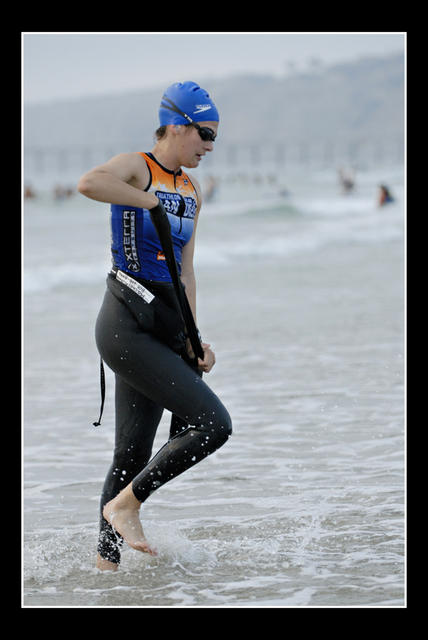


Imperial Beach Tri Pics (8/27/06)


Official Results:
TRIATHLON - 1/2K swim, 15K bike, 3.2 mile run
Time Overall 1:19:25
Swim + T1: 0:14:01
Bike + T2: 0:36:11
Run: 0:29:13
Place (not that it really matters):
AG: 10/21
OA: 309/700+
My post-mortem analysis:
My overall time was okay, and I had a good race, felt strong, and had a good time.
My swim time seems really, really slow. But when I figure that it includes T1 and that the surf was especially bad, I guess it wasn't that bad.
Bike: Don't really think I could have done much better. I'm happy with this time for where I am right now.
Run: W.T.F.?! My running has been getting slower and slower. I felt like I maintained a good pace and good form, and I normally don't run almost 10 min/miles. It's way past the time I start hitting the track for some speed workouts!!!
TRIATHLON - 1/2K swim, 15K bike, 3.2 mile run
Time Overall 1:19:25
Swim + T1: 0:14:01
Bike + T2: 0:36:11
Run: 0:29:13
Place (not that it really matters):
AG: 10/21
OA: 309/700+
My post-mortem analysis:
My overall time was okay, and I had a good race, felt strong, and had a good time.
My swim time seems really, really slow. But when I figure that it includes T1 and that the surf was especially bad, I guess it wasn't that bad.
Bike: Don't really think I could have done much better. I'm happy with this time for where I am right now.
Run: W.T.F.?! My running has been getting slower and slower. I felt like I maintained a good pace and good form, and I normally don't run almost 10 min/miles. It's way past the time I start hitting the track for some speed workouts!!!
Monday, August 28, 2006
Squeezed in a Run
I can't believe how incredibly swamped I am. I can't seem to get ahead. I have to give lab meeting tomorrow (again--got suckered into it), and it's taken up ALL my time.
At 6:00, I made myself stop, change, and head out the door for a nice, gentle 4-mile run. Ah, the gorgeous sun setting over the Pacific as I ran along Torrey Pines. The smell of freshly cut grass emanating from the Torrey Pines Golf course. Do I actually live here? I'm glad I made myself do it. If I can just do a little something every day.
Now, back to work....Anyone want to hear about ApoAI, HDL, and reverse cholesterol transport?
At 6:00, I made myself stop, change, and head out the door for a nice, gentle 4-mile run. Ah, the gorgeous sun setting over the Pacific as I ran along Torrey Pines. The smell of freshly cut grass emanating from the Torrey Pines Golf course. Do I actually live here? I'm glad I made myself do it. If I can just do a little something every day.
Now, back to work....Anyone want to hear about ApoAI, HDL, and reverse cholesterol transport?
Sunday, August 27, 2006
Check it out
I added 3 posts since Friday to help organize things. Just a note so you don't forget to read below!
Imperial Beach Tri 8-27-06
On Sunday, I woke up, rarin' to go for the Imperial Beach Triathlon. I felt well-rested and prepared. It was "just" a sprint, and I can finally say that I can do a sprint and it doesn't kill me anymore. I can actually go out there and relax and have fun and put forth a good effort. It feels good to reflect on how far I've come. There weren't that many people there, which gave it a laid-back, friendly atmosphere. The swim was surprisingly tough. Even though the water looked gentle and calm the day before and had felt warm, Sunday morning brought some rough surf and FREEZING cold water. I forced myself to warm-up, vital for a sprint when the swim is over before it begins. Hurried to the start and got completely pummeled by a wave coming in. I hate when a big wave sneaks up from behind and you get caught in just the wrong way. You get sucked under and don't know which way is up or down. I try to let myself go limp, and I can feel the force and power of the ocean taking my body and bending it forward and backward at its whim. There's always that terrifying moment when I'm not sure if the wave is going to snap me in two or bash my head on the ground (in addition to breathing in a ton of water). I stay calm and zen out, and sure enough, I always end up popping up like a drowned rat, with the ebbing surf giggling after me. After getting spun around and swallowing a good deal of salt water, I shook it off and lined up on the start. The actual swim itself was pretty uneventful after my traumatic warm-up. I had no problem jumping on the bike and pedaling off, although I had to yell twice at people (spectators) to get off the course. Oh, and another time when a volunteer waved a bus through an intersection that I was barreling through. Hello! I'm riding here! But I kept my road rage in check. The bike felt awesome. It was over so quickly. Then, I was off and running. Found my stride and felt myself relax into it. I ended up pacing next to another woman in my age group I introduced myself and we chatted the rest of the way. It's so nice to meet people like that at these events. Makes it a little less lonely. I had a great surge across the finish and met someone else in a tri club uniform afterwards. I'm constantly amazed at how friendly everyone is in this sport in San Diego and how easy it is to meet good people. It's very refreshing. Especially b/c that hasn't always been my experience.
Finish time ~1:20
Finish time ~1:20
TCSD Aquathlon 8-24-06
By the way, the Aquathlon on Thursday was great. As always, I saw lots of great people, which is one of the best reasons to attend these things. I also met new people, including, Paul, which was awesome. Always good to meet fellow bloggers! I had a good, strong swim and run. I wasn't fast but I was steady. My base is still there, and that's what matters. The water was very inviting and warm. I saw lots of sting rays and leopard sharks! They're harmless but they swim in such shallow water; it's kind of freaky to see these long, skinny fish zipping under your arm. Yikes! The run was tough--on sand and a 2-lap course, which is mentally tough. But I actually felt better and better as I ran. I think the first 2 miles for me always suck. I'm such a long, slow distance person now. Guess it comes from the training.
Finish time: ~50 min
Finish time: ~50 min
Fighting the fatigue--I think I'm winning
I've been gradually returning to normal after my horrendous 3-week illness which set me back and ultimately caused me to forgo AFC's 1/2 marathon last weekend. It's been a slippery uphill slope. On a day-to-day basis, I can't gauge my improvement. But on a weekly basis, I can see I have more energy and am feeling better and better. I think a combination of overtraining causing a weakened immune system and an ill-fated gastric infection from the dairy farm (plus another virus to boot) caused me to fall flat on my back. However, it's been unusually difficult to beat the fatigue and get back to my perky self. It could be the virus in my system plus the stomach bug just took a large toll that my body will need a few months to reover from (many viruses can cause fatigue in patients lasting several weeks).
Just to be safe, I went to the doctor and had some tests done. My blood tests came back normal (almost). Turns out, I may have low thyroid (see below for more info on low thyroid). At age 28! My whole family has low thyroid and though I don't display some of the more common symptoms (weight gain), I do have a hard time keeping warm and have been extremely tired lately. So the doc ran a simple blood test. My thyroid hormone was on the low side (0.8) but not out of the normal range (0.8 to 1.6). But my TSH was almost 30. What? Off the charts! Anything over 4 "merits treatment." The doc wanted to start me on a high dose of daily thryoid medication. However, it's a pretty serious drug with some potentially adverse side effects (erratic heart beat was the one that caught my eye) so I went and got a 2nd opinion from a more conservative doc. This one will probably recommend thyroid treatment as well but he'll probably start me off on a lower dose. Plus, he's comparing these results to results 2 years ago (normal), and he's redoing the lab work (yea! needles!) in a few weeks to make sure. Hey, I'm a scientist. I need something more than an n of 1 to confirm off-the-chart results before getting excited. 29 just seems too high to be believable. Plus, the 2nd doc said illness could cause fluctuations in thyroid levels. Hmmmm. Did the illness cause the thyroid issues or the other way around. Hmmm.
I like the 2nd doc much better than the first one. The first one just wanted to get me on drugs and out of the office. Not acceptable. You really have to be your own health care advocate these days. Do the research. Know your body and your symptoms. Don't be afraid to get a 2nd opinion. Take the time to find a doctor you trust and can work with. Your doctor should respect your symptoms and your previous knowledge of your body. You know it better than anyone else. But I digress...
Anyway, I'm addressing my ridiculous fatigue. I'm doing all the right things, and I'm getting it figured out. I figure, if it's low thyroid, I've probably been developing it for some time and can hold off treatment for a few more weeks (zzzz) while I take the time to do the lab work correctly to confirm that is actually what's wrong.
In the meantime, I've been addressing my fatigue in other ways. I avoid caffeine late in the day. I go to bed early. I avoid naps like the plague, even if it means I'm a mega-bitch in the afternoons. I try to eat small, healthy meals frequently throughout the day. I make myself take breaks and restrain myself from going overboard on any one activity, which I'm prone to doing. I exercise almost every day but don't overdo it. Sigh. This level of discipline is tiring in and of itself but it does seem to keep me productive and functional as I get my fatigue figured out.
Another possibility is chronic fatigue syndrome (CFS), which is basically overwhelming fatigue and symptoms similar to the flu without having any indications otherwise (that can be detected) that there is anything physically wrong. Experts believe it could be due to a poorly functioning immune system or triggered by a virus but no one is really sure.
What struck me in reading about CFS was its similarity to overtraining syndrome. Indeed, in some articles about possible triggers for CFS, overtraining was actually listed. Interesting. In addition, in reading about overtraining, some articles stated that if overtraining was not addressed (by rest), symptoms could become chronic. I don't think I have CFS because my symptoms are not persistent enough and have not lasted for long enough. But it's just another illustration of what could happen if I ignored what my body is telling me. I think all the racing and hard training days I did back-to-back this summer took its toll. It's just another warning to myself to pull back, take it easy, and let my body recover. I'm amazed at how easy it is to trick yourself into overtraining mode in triathlon.
Overall, I feel really good about this week. 1. I found a doctor I like and who I can work with, and 2. I think I found a solution to my long-lasting fatiuge. 3. I've been able to control my fatigue somewhat through more rest, pacing myself, and nutrition and 4. was able to have a productive week both in lab, at home, and in training. 5. I did a workout almost every day--ran on Monday, swam on Tuesday, biked on Wednesday, did a club Aquathlon on Thursday, rested (smart) on Fri and Sat, and did the Imperial Beach Tri on Sunday. Tonight, I'm resting, eating, doing a little housework catching-up, a little reading for lab, and a lot of petting the buns.
By the way, the Aquathlon on Thursday was great. As always, I saw lots of great people, which is one of the best reasons to attend these things. I also met new people, including, Paul, which was awesome. Always good to meet fellow bloggers! I had a good, strong swim and run. I wasn't fast but I was steady. My base is still there, and that's what matters. The water was very inviting and warm. I saw lots of sting rays and leopard sharks! They're harmless but they swim in such shallow water; it's kind of freaky to see these long, skinny fish zipping under your arm. Yikes! The run was tough--on sand and a 2-lap course, which is mentally tough. But I actually felt better and better as I ran. I think the first 2 miles for me always suck. I'm such a long, slow distance person now. Guess it comes from the training.
On Sunday, I woke up, rarin' to go for the Imperial Beach Triathlon. I felt well-rested and prepared. It was "just" a sprint, and I can finally say that I can do a sprint and it doesn't kill me anymore. I can actually go out there and relax and have fun and put forth a good effort. It feels good to reflect on how far I've come. There weren't that many people there, which gave it a laid-back, friendly atmosphere. The swim was surprisingly tough. Even though the water looked gentle and calm the day before and had felt warm, Sunday morning brought some rough surf and FREEZING cold water. I forced myself to warm-up, vital for a sprint when the swim is over before it begins. Hurried to the start and got completely pummeled by a wave coming in. I hate when a big wave sneaks up from behind and you get caught in just the wrong way. You get sucked under and don't know which way is up or down. I try to let myself go limp, and I can feel the force and power of the ocean taking my body and bending it forward and backward at its whim. There's always that terrifying moment when I'm not sure if the wave is going to snap me in two or bash my head on the ground (in addition to breathing in a ton of water). I stay calm and zen out, and sure enough, I always end up popping up like a drowned rat, with the ebbing surf giggling after me. After getting spun around and swallowing a good deal of salt water, I shook it off and lined up on the start. The actual swim itself was pretty uneventful after my traumatic warm-up. I had no problem jumping on the bike and pedaling off, although I had to yell twice at people (spectators) to get off the course. Oh, and another time when a volunteer waved a bus through an intersection that I was barreling through. Hello! I'm riding here! But I kept my road rage in check. The bike felt awesome. It was over so quickly. Then, I was off and running. Found my stride and felt myself relax into it. I ended up pacing next to another woman in my age group I introduced myself and we chatted the rest of the way. It's so nice to meet people like that at these events. Makes it a little less lonely. I had a great surge across the finish and met someone else in a tri club uniform afterwards. I'm constantly amazed at how friendly everyone is in this sport in San Diego and how easy it is to meet good people. It's very refreshing. Especially b/c that hasn't always been my experience.
The rest of the day has been sleeping and relaxing. I'm going to hang back and restrain myself now to focus on training and being healthy. I'm gearing up for the San Jose Rock 'N Roll 1/2 Marathon Oct. 8th. Already have done most of the training since I just missed the last one so I really just want to maintain my base and have fun. After that, it's season wrap-up time (even though the season never really ends in San Diego) and a little rest before gearing up for next season. I'm already writing up a list of races I want to do (I have to cut several. sigh. too many. a happy problem) for 2007.
Informative websites on low thyroid:
Doctor Yourself
Endocrine Web
About.com
Project Aware
Symptoms of Low Thyroid:
- lethargy and decreased energy
- cold intolerance
- muscle cramps
- muscle pain and stiffness
- constipation
- weight gain
- dry skin
- mental slowing
- course hair and skin
- depression
Informative websites on chronic fatigue syndrome (CFS ):
The Free Dictionary
Life Extension
CDC
CFIDS
Family Doctor
Symptoms of CFS:
Four or more of the following symptoms must have been present for longer than six months:
- Short-term memory loss or a severe inability to concentrate that affects work, school, or other normal activities.
- Sore throat.
- Swollen lymph nodes in the neck or armpits.
- Muscle pain or weakness.
- Pain without redness or swelling in a number of joints.
- Intense or changing patterns of headaches.
- Unrefreshing sleep.
- After any exertion, weariness that lasts for more than a day.
2. The fatigue must be severe as indicated by the following:
- Sleep or rest does not relieve it.
- The fatigue is not the result of excessive work or exercise.
- The fatigue substantially impairs a person's ability to function normally at home, at work, and in social occasions.
- Even mild exercise often makes the symptoms, especially fatigue, much worse.
3. The fatigue must be a new, not lifelong, condition with a definite time of onset. Often, the condition first appears as a viral upper respiratory tract infection marked by some combination of fever, headache, muscle aches, sore throat, earache, congestion, runny nose, cough, diarrhea, and fatigue. Typically, the initial illness is no more severe than any cold or flu.
4. The symptoms must persist. In ordinary infections, symptoms go away after a few days, but in CFS, fatigue and other symptoms recur or continue for months to years. Many patients experience symptoms as recurring bouts of flu-like illness, with each attack lasting from hours to weeks.
Note: Other symptoms reported with CFS but not part of the criteria include intolerance to alcohol, irritable bowel syndrome, dry eyes and mouth, impaired circulation in the hands and feet, visual disturbances, and painful menstrual periods in women.
Overtraining and CFS:
BMJ
Sports Injury Bulletin
Emotional Processing & Physical Health
Friday, August 25, 2006
How NOT to Go On a Bike Ride
1. Scramble out the door at 6:30 to make it for an evening bike ride.
2. Forget your water bottle and be too lazy to go back inside and get it.
(The security guard locked me out, and I would have had to clip-clop all the way around the building in my bike shoes).
3. Forget that the sun is setting earlier now that it's late summer and that it no longer stays light until 8 or 8:30.
4. Feel really good at the turn-around point and say, "Screw it! Let's go out just a bit longer."
5. When you reach the turn-around point, decide you feel SO good that you should make a loop instead of an out-and-back ride.
6. Decide to "find" this loop by doing some exploring and ride down roads never ridden before (a.k.a. basically, get lost on purpose).
Note to self: Just because a road starts out going in the right direction doesn't mean it's going to stay that way.
7. Aforementioned never-ridden-before roads are windy, narrow, and have no bike lanes.
8. And of course, these roads have lots of traffic and are super hilly.
9. Oh, and ride by yourself.
10. Neglect to have any sort of lights for night riding or luminescence whatsoever.
At mile, 21 as dusk had more than fallen and all the cars passing me now had their headlights on, I realized I still had a good 8-or-so miles to go before reaching home. I decided to surrender. I pulled over into a restaurant parking lot, noting the name of the restaurant, the road I was on, and the intersecting street. I then pulled out my handy cell phone and called Jason to come and rescue me. Sigh. It was a great ride despite my brazen idiocracy. He brought the bike rack, a lock, and a change of clothes and took me out to eat at a local brewery and restaurant (Rock Bottom), which put a nice finishing touch on the evening.
2. Forget your water bottle and be too lazy to go back inside and get it.
(The security guard locked me out, and I would have had to clip-clop all the way around the building in my bike shoes).
3. Forget that the sun is setting earlier now that it's late summer and that it no longer stays light until 8 or 8:30.
4. Feel really good at the turn-around point and say, "Screw it! Let's go out just a bit longer."
5. When you reach the turn-around point, decide you feel SO good that you should make a loop instead of an out-and-back ride.
6. Decide to "find" this loop by doing some exploring and ride down roads never ridden before (a.k.a. basically, get lost on purpose).
Note to self: Just because a road starts out going in the right direction doesn't mean it's going to stay that way.
7. Aforementioned never-ridden-before roads are windy, narrow, and have no bike lanes.
8. And of course, these roads have lots of traffic and are super hilly.
9. Oh, and ride by yourself.
10. Neglect to have any sort of lights for night riding or luminescence whatsoever.
At mile, 21 as dusk had more than fallen and all the cars passing me now had their headlights on, I realized I still had a good 8-or-so miles to go before reaching home. I decided to surrender. I pulled over into a restaurant parking lot, noting the name of the restaurant, the road I was on, and the intersecting street. I then pulled out my handy cell phone and called Jason to come and rescue me. Sigh. It was a great ride despite my brazen idiocracy. He brought the bike rack, a lock, and a change of clothes and took me out to eat at a local brewery and restaurant (Rock Bottom), which put a nice finishing touch on the evening.
Sunday, August 20, 2006
Volunteering for America's Finest City Half-Marathon
Note: Thanks for all the great responses to the fat-burning post. You may want to check it out again. I added yet another "expert" response and a "recap" section to the bottom to sort out all the info.
Congrats to my friend J. and my husband, Jason, who both completed America's Finest City Half Marathon yesterday! I was kind of bummed not to be doing it myself but it was nice to go and support Jason. He finished looking very strong. Plus, I decided to volunteer. It was actually a privelege. I led the handicapped division on my bike to show them the way. Not only did I get to see the race from an awesome perspective (the front--one place I could never be except in a situation like this), but I got a bike ride in too! Because it was a one-way course, Jason dropped me off at the start, and I biked to the front, which was the workout. Then, I just relaxed and did a sort of recovery ride the other way, leading the handicapped division.
Let me just say, that the handicapped athletes were not at all handicapped! They were much faster than I could ever hope to be! One athlete ran with a prosthetic, and we passed mile marker 1 in under 5 minutes! Unbelieavable. The other 3 handicapped athletes were double leg amputees and zipped down the course in wheelchairs. Although going uphill was sometimes a challenge (all arms!), there were several times I had to push it to keep ahead. I did not expect to be getting that much of a workout! Fantastic. Plus, at one point, one of the athletes dropped a velcro strap which I turned around and sprinted to retrieve before the other runners caught up.
We started 5 minutes before the runners, and the lead runner didn't pass us until well after mile 11. It was incredible. I was transfixed, watching the lead Kenyan run away from me. His biomechanics were flawless. Each leg landed directly under him in a fixed rhythm. He looked like he was floating. He wasn't even breathing hard, and this was going up the hellish 1-mile hill at mile 12. He finished the race in under 1:03!!! He had flown in from Kenyan Friday night! I wonder what he runs like when he's not jet-lagged!
"Wilson Chebet, a Kenyan racing for the first time on American soil, and Russian Tatiana Chulakh who defended her title on Sunday. Chebet won in 1 hour, 2 minutes, 38 seconds, the second fastest time in the race's history and 14 seconds shy of the course record, while Chulakh ran 1:14:12. Both athletes were awarded $1500 for their victories. Over 5,948 participants enjoyed the hilly but scenic point-to-point course under mercifully-cloudy skies and temperatures in the upper 60s."
Runner's Web news
Oh, and the athletes in the handicapped division? We came in shortly after, in under 1:10!!! After we finished, I went over and congratulated the athletes in the handicapped division. They were from Brazil and spoke limited English but fluent Spanish. Hablo piquito espanol so all I could manage was "Muy bien!" very enthusiastically. I definitely have a reinforced respect for physically challenged athletes. They are more fit than I am, and I have 4 functional limbs!
I then settled in by the finishing chute and watched the competitors sprint in. Yes, sprint. They made it look so easy. It was amazing to see such finely toned, highly-muscled legs. This one woman came floating past, and a crowd of fans cheered her on. I thought they were saying, "Kaylie," but than the announcer came on and said it was "Michellie Jones." Wow. I actually got to see her. And that's just a small training workout for her. She's been in many of the same races I've done this season since she lives in the area but I never got to see her before since she's always done by the time I start. It was so cool to actually see her. Very inspiring. Now, I just want to get out and go for a run!
Friday, August 18, 2006
Myth of Fat-Burning Zone Debunked
I got a really good question today about exercise and training. Thought it might be kind of informative so I put it up here as well.
Question: fat burning zone???
Does anyone know how and if this really works? I went for a run (if>you can call it that) with a friend and it was the most painful thing>to do becuase we were staying in our "fat burning zone". Her father>lost over 30 lbs using a monitor and staying in the FBZ, so he bought>her one. She has always been a runner and nothing has changed on her>body until she started staying in her FBZ. She was 131lbs, 27% body>fat and now she's 122lbs, 22% body fat. She lost 9lbs in 1.5 months.>This is completely different then I've evered trained. It was so hard>to go that slow and easy. But all the "hard" training I do has not>helped me get rid of the extra weight I would like to so I can improve>as a triathlete. I wonder if I should incorporate some of these>slower, steadier workouts in.
Answer:
From what I've heard, the "experts" in the exercise community advocate exercising at a higher intensity rather than staying in the "fat burning zone." The original rationale behind the fat burning zone was that when you're exercising at a slower rate, your heart rate is slower, and the calories burned come from a larger percentage of fat than from glycogen (glucose). That is why long-distance triathletes also train at a slower pace. They want to avoid using up their limited glycogen stores since our fat stores are much greater and can provide a lot more energy than glucose. The downside is that it takes longer to break down fat to use for energy so when we begin training at a faster pace, our heart rates rise, our needs for energy increase, and the time it takes to breakdown fat is too slow to completely meet the demands of the body. As we train a bit harder, our energy comes from both fat and glycogen. Then, if we do a flat-out sprint, our body depends purely (100%) on glycogen at this point, which we can do for a very limited amount of time (under a minute). This is termed "anaerobic" and is not very useful for triathletes.
How does this apply to weight loss? For weight loss and exercise, your main concern is burning calories. It doesn't matter whether it comes from fat or glycogen. This is partly because glycogen can become fat and fat can become glycogen. In addition, our bodies use a mixture of both all the time. Basically, a calorie is a calorie and a net loss will lead to shedding of pounds. The more intensely you exercise, the more calories you burn so that is why exercise gurus advocate exercising at a higher intensity than the "fat-burning zone." You will burn more calories if you exercise at a higher intensity than a slower, fat-burning one during the same time period. On the other hand, the longer you exercise, the more calories you burn too. You don't want to go all-out and have to quit 5 minutes into your workout.
A lot of trainers nowadays are advocating interval training, where you alternate higher-intensity periods with low-intensity "recovery" periods. For instance, if you were biking, you could go hard for 5 minutes and then recover for 1 minute. The idea is that you can sustain this for a long period of time and still workout at a higher intensity. It also challenges your body more than if you were to maintain the same pace the whole time, which works different muscles, and also toasts calories.
Other Answers:
These were other responses from some "experts" (excerise physiologists, nutritionists, etc.)
Response #1:
Something I have noted from personal experience is that by doing high intensity training you increase your tolerance for discomfort and depending on the level of intensity improve your anaerobic threshold. As this improves you are able to train harder for the same period of time and burn more calories or train at the same level of intensity for longer. Basically the fitter a person is the more calories then can efficiently burn in the same time period. You will see fitness improvements with low fbz training but eventually you will be limited by lack of anaerobic fitness, this will really start to hurt athletic performances that are common in a triathlon. FBZ (fat burning zone) training is great for easing into to the world of exercise and fitness as will initially help prevent discouragement due to discomfort and early training injuries when people do too much too fast. However I doubt you will ever get down to 5-10% body fat or perform very well in competitions without mixing in some higher intensity stuff. I also feel that after a high intensity workout you continue to burn more calories for longer during the recovery period.
Response #2:
The analogy I use is as follows:
Sit on the couch and we’ll burn the highest percentage of fat but obviously this training technique is not as effective as training in the FBZ. In the long run, 3500 calories equals 1 pound of fat and we burn the most calories per hour when we train “out of our comfort zone” or at higher intensities. The weight loss your friend has seen has to do with energy balance so obviously there was a situation where she was burning more than she was consuming too to allow for that weight loss to occur
Response #3:
This is actually a big misconception, and if you're looking for a "training effect" for triathlon, then this FBZ training is not for you. The misconception is that you "burn more fat". Yes, you burn a greater percentage of fat when training at that slower pace, but you DO NOT ACTUALLY BURN MORE FAT than training with more intensity.
When you increase the intensities of your workouts, you will burn a greater percentage of glycogen, and less percentage of fat, but the amount of ACTUAL FAT BURNED will be greater than going slower, or staying in the FBZ, and you will also get a better training effect. I can't quite recall any specific numbers from the research I've done, but it's not a significant percentage difference, and the intensity makes a BIG difference in the results of the workout!
If you're trying to get faster for triathlon, then you need to be focused on your intensity, not FBZ. Does this mean you should not include any Zone 1 workouts in your training? No, you should! But it should not be the focus of your training. This will also be dependent on your triathlon race goals, such as sprint distance vs. Ironman.
Response #4:
As with many concepts related to exercise training and the many related benefits, the effects and the rate of change can be quite specific to each individual, especially when we are talking about weight loss or body fat changes. However, there are recommendations that are backed by science that can be helpful when trying to maximize the fat burn training effect without jeopardizing your health or endurance performance level.
Specifically, related to your question "should I workout slower to optimize" fat burning?" Let me suggest to you that there is indeed a specific zone of intensity where you will burn the highest amount of fat calories per minute. Unfortunately, depending on the individual, those fat calories may not add up very quickly.
For example: during metabolic exercise testing and through a method call indirect calorimetry, scientists can evaluate the concentration of fat and carbohydrates that are utilized for energy at different intensities. Usually, during rest and at the lower exercise intensities we see the highest percentage of fat utilized. Keep in mind though, at rest and low intensity the overall calorie burn is quite low. So, if you are exercising in zone 1 you may be burning mostly fat, but your calories expended will take a lot longer to add up. Additionally, if you are not at a high fitness level you may be burning even less fat because you are doing even less work. For example, an elite level triathlete may be able to run an 8-minute mile pace with his or her heart rate in zone one (i.e., very lowintensity). Running at that speed will require a very generous amount of calories to sustain and most of it will be derived from fat. Alternatively, if I were running an 8-minute mile pace my level of intensity would be much higher and closer to, if not exceeding, the lactate threshold. That would put me at a zone 3 or 4 intensity level, which would require mostly carbohydrates since I'm already exceeding my fat burning zone. NOW KEEP IN MIND if I weighed the same as the elite athlete we would be burning close to the same amount of total calories to run that 8-minute mile pace. If we both ran an hour the elite athlete will have burned most of his or her calories from fat while I will have depleted much of my carbohydrate stores and very little fat due to "harder training".
QUICK REVEIW: As exercise intensity goes up so does the overall calorie expenditure, however the fat burn will usually increase only to a limited expenditure rate as other energy systems need to take over. Often, as your intensity approaches and surpasses the lactate threshold, metabolic testing reveals little to no fat calories expended and energy is derived from nearly100% carbohydrates. So, according to the above analogy you might surmise that I need to slow down if I am going to burn fat and ultimately lose body fat. However, things are not always how they seem. In reality my goal should be to become fitter so that when I run in zone 1 or 2 I am not doing a shuffle step or walk to keep my heart rate down. I do this by training at levels that stimulate continued improvement in my lactate threshold (LT). Training to increase my LT or sometimes referred to as the anaerobic threshold has been shown to be most effective when combining a variety of training levels. Specifically, sometimes I should train at or slightly above the lactate threshold (zones3-4) to stimulate LT overload adaptations and other times during longer bouts (zone 1-2) to enhance aerobic kinetics and fat burning adaptations. So there are different adapations at different intensities (i.e.,specificity of training).
Special Note: Recovery after the harder workouts is a key to seeing threshold improvements. As my threshold improves so does my sustainable pace and so does my ability to burn more fat calories and the total calories during exercise. Also, keep in mind the fact that burning off the extra body fat is dependent on how many total calories you expend at the end of the day as compared to how many you take in from food. So the additive effect of all exercise and activity will promote body fat loss.
Let me introduce a couple more energy/training related concepts that mighthelp you further understand the mechanisms involved with burning caloriesand losing body fat.
1. In the lab exercise scientists have discovered that exercise that is intense but sustainable (at or around your LT) for bouts up to an hour can have significant effects on how many calories you burn post exercise. There is a term for this called EPOC or excess post oxygen consumption. This concept suggests that you not only can burn calories during exercise but when sufficient work levels are sustained we can see additional calories, specifically fat, burned for several hours after exercise. However, usually individuals who are not very fit will have limited benefit from extra fat burned post exercise because they are generally not able to sustain work rates high enough to accumulate much of an additive effect from the fat burned.
SPECIAL NOTE: hard sustained exercise creates higher EPOC which alsorequires a longer recovery period because of the stress on the system and depleted energy stores.
2. There are studies that show elite endurance athletes who burn well over4,000 kcals per day often may only consume 2500-3000 kcals. These athletes continue to function and train for months on end and didn't necessarily continue to lose body fat (note: this low calorie intake is quite common among endurance athletes). Studies observed that the athlete’s metabolism adjusted to adapt to the limited energy intake by holding on to the stored fat. It was suggested that the training effect was also compromised due tothe lower fuel intake. The point I am making here is that how much and when you fuel your body can have an effect on your ability to use and burn fat. High stress loads with limited fuel restoration and recovery can affect metabolism for the worse. In summary, how to maximize your body fat burn is a comprehensive approach, not usually accomplished by quick and easy methods. We've all heard that there are no quick solutions like pills and starvation diets. Similarly, even the "fat burn zone" by itself is not as easy an answer as we might like.
Wow! That's a lot of great info. If you are overwhelmed, like me, here's a quick summary:
RECAP:
1. Basically, a calorie is a calorie and a net loss will lead to shedding of pounds.
We burn the most calories per hour when we train “out of our comfort zone” or at higher intensities. You burn a greater percentage of fat when training at that slower pace, but you DO NOT ACTUALLY BURN MORE FAT than training with more intensity. Burning off the extra body fat is dependent on how many total calories you expend at the end of the day compared to how many you take in from food. So the additive effect of all exercise and activity will promote body fat loss.
2. Alternate higher-intensity periods with low-intensity "recovery" periods.
If you're trying to get faster for triathlon, then you need to be focused on your intensity, not FBZ.
Specifically, sometimes I should train at or slightly above the lactate threshold (zones3-4) to stimulate LT overload adaptations and other times during longer bouts (zone 1-2) to enhance aerobic kinetics and fat burning adaptations.
Question: fat burning zone???
Does anyone know how and if this really works? I went for a run (if>you can call it that) with a friend and it was the most painful thing>to do becuase we were staying in our "fat burning zone". Her father>lost over 30 lbs using a monitor and staying in the FBZ, so he bought>her one. She has always been a runner and nothing has changed on her>body until she started staying in her FBZ. She was 131lbs, 27% body>fat and now she's 122lbs, 22% body fat. She lost 9lbs in 1.5 months.>This is completely different then I've evered trained. It was so hard>to go that slow and easy. But all the "hard" training I do has not>helped me get rid of the extra weight I would like to so I can improve>as a triathlete. I wonder if I should incorporate some of these>slower, steadier workouts in.
Answer:
From what I've heard, the "experts" in the exercise community advocate exercising at a higher intensity rather than staying in the "fat burning zone." The original rationale behind the fat burning zone was that when you're exercising at a slower rate, your heart rate is slower, and the calories burned come from a larger percentage of fat than from glycogen (glucose). That is why long-distance triathletes also train at a slower pace. They want to avoid using up their limited glycogen stores since our fat stores are much greater and can provide a lot more energy than glucose. The downside is that it takes longer to break down fat to use for energy so when we begin training at a faster pace, our heart rates rise, our needs for energy increase, and the time it takes to breakdown fat is too slow to completely meet the demands of the body. As we train a bit harder, our energy comes from both fat and glycogen. Then, if we do a flat-out sprint, our body depends purely (100%) on glycogen at this point, which we can do for a very limited amount of time (under a minute). This is termed "anaerobic" and is not very useful for triathletes.
How does this apply to weight loss? For weight loss and exercise, your main concern is burning calories. It doesn't matter whether it comes from fat or glycogen. This is partly because glycogen can become fat and fat can become glycogen. In addition, our bodies use a mixture of both all the time. Basically, a calorie is a calorie and a net loss will lead to shedding of pounds. The more intensely you exercise, the more calories you burn so that is why exercise gurus advocate exercising at a higher intensity than the "fat-burning zone." You will burn more calories if you exercise at a higher intensity than a slower, fat-burning one during the same time period. On the other hand, the longer you exercise, the more calories you burn too. You don't want to go all-out and have to quit 5 minutes into your workout.
A lot of trainers nowadays are advocating interval training, where you alternate higher-intensity periods with low-intensity "recovery" periods. For instance, if you were biking, you could go hard for 5 minutes and then recover for 1 minute. The idea is that you can sustain this for a long period of time and still workout at a higher intensity. It also challenges your body more than if you were to maintain the same pace the whole time, which works different muscles, and also toasts calories.
Other Answers:
These were other responses from some "experts" (excerise physiologists, nutritionists, etc.)
Response #1:
Something I have noted from personal experience is that by doing high intensity training you increase your tolerance for discomfort and depending on the level of intensity improve your anaerobic threshold. As this improves you are able to train harder for the same period of time and burn more calories or train at the same level of intensity for longer. Basically the fitter a person is the more calories then can efficiently burn in the same time period. You will see fitness improvements with low fbz training but eventually you will be limited by lack of anaerobic fitness, this will really start to hurt athletic performances that are common in a triathlon. FBZ (fat burning zone) training is great for easing into to the world of exercise and fitness as will initially help prevent discouragement due to discomfort and early training injuries when people do too much too fast. However I doubt you will ever get down to 5-10% body fat or perform very well in competitions without mixing in some higher intensity stuff. I also feel that after a high intensity workout you continue to burn more calories for longer during the recovery period.
Response #2:
The analogy I use is as follows:
Sit on the couch and we’ll burn the highest percentage of fat but obviously this training technique is not as effective as training in the FBZ. In the long run, 3500 calories equals 1 pound of fat and we burn the most calories per hour when we train “out of our comfort zone” or at higher intensities. The weight loss your friend has seen has to do with energy balance so obviously there was a situation where she was burning more than she was consuming too to allow for that weight loss to occur
Response #3:
This is actually a big misconception, and if you're looking for a "training effect" for triathlon, then this FBZ training is not for you. The misconception is that you "burn more fat". Yes, you burn a greater percentage of fat when training at that slower pace, but you DO NOT ACTUALLY BURN MORE FAT than training with more intensity.
When you increase the intensities of your workouts, you will burn a greater percentage of glycogen, and less percentage of fat, but the amount of ACTUAL FAT BURNED will be greater than going slower, or staying in the FBZ, and you will also get a better training effect. I can't quite recall any specific numbers from the research I've done, but it's not a significant percentage difference, and the intensity makes a BIG difference in the results of the workout!
If you're trying to get faster for triathlon, then you need to be focused on your intensity, not FBZ. Does this mean you should not include any Zone 1 workouts in your training? No, you should! But it should not be the focus of your training. This will also be dependent on your triathlon race goals, such as sprint distance vs. Ironman.
Response #4:
As with many concepts related to exercise training and the many related benefits, the effects and the rate of change can be quite specific to each individual, especially when we are talking about weight loss or body fat changes. However, there are recommendations that are backed by science that can be helpful when trying to maximize the fat burn training effect without jeopardizing your health or endurance performance level.
Specifically, related to your question "should I workout slower to optimize" fat burning?" Let me suggest to you that there is indeed a specific zone of intensity where you will burn the highest amount of fat calories per minute. Unfortunately, depending on the individual, those fat calories may not add up very quickly.
For example: during metabolic exercise testing and through a method call indirect calorimetry, scientists can evaluate the concentration of fat and carbohydrates that are utilized for energy at different intensities. Usually, during rest and at the lower exercise intensities we see the highest percentage of fat utilized. Keep in mind though, at rest and low intensity the overall calorie burn is quite low. So, if you are exercising in zone 1 you may be burning mostly fat, but your calories expended will take a lot longer to add up. Additionally, if you are not at a high fitness level you may be burning even less fat because you are doing even less work. For example, an elite level triathlete may be able to run an 8-minute mile pace with his or her heart rate in zone one (i.e., very lowintensity). Running at that speed will require a very generous amount of calories to sustain and most of it will be derived from fat. Alternatively, if I were running an 8-minute mile pace my level of intensity would be much higher and closer to, if not exceeding, the lactate threshold. That would put me at a zone 3 or 4 intensity level, which would require mostly carbohydrates since I'm already exceeding my fat burning zone. NOW KEEP IN MIND if I weighed the same as the elite athlete we would be burning close to the same amount of total calories to run that 8-minute mile pace. If we both ran an hour the elite athlete will have burned most of his or her calories from fat while I will have depleted much of my carbohydrate stores and very little fat due to "harder training".
QUICK REVEIW: As exercise intensity goes up so does the overall calorie expenditure, however the fat burn will usually increase only to a limited expenditure rate as other energy systems need to take over. Often, as your intensity approaches and surpasses the lactate threshold, metabolic testing reveals little to no fat calories expended and energy is derived from nearly100% carbohydrates. So, according to the above analogy you might surmise that I need to slow down if I am going to burn fat and ultimately lose body fat. However, things are not always how they seem. In reality my goal should be to become fitter so that when I run in zone 1 or 2 I am not doing a shuffle step or walk to keep my heart rate down. I do this by training at levels that stimulate continued improvement in my lactate threshold (LT). Training to increase my LT or sometimes referred to as the anaerobic threshold has been shown to be most effective when combining a variety of training levels. Specifically, sometimes I should train at or slightly above the lactate threshold (zones3-4) to stimulate LT overload adaptations and other times during longer bouts (zone 1-2) to enhance aerobic kinetics and fat burning adaptations. So there are different adapations at different intensities (i.e.,specificity of training).
Special Note: Recovery after the harder workouts is a key to seeing threshold improvements. As my threshold improves so does my sustainable pace and so does my ability to burn more fat calories and the total calories during exercise. Also, keep in mind the fact that burning off the extra body fat is dependent on how many total calories you expend at the end of the day as compared to how many you take in from food. So the additive effect of all exercise and activity will promote body fat loss.
Let me introduce a couple more energy/training related concepts that mighthelp you further understand the mechanisms involved with burning caloriesand losing body fat.
1. In the lab exercise scientists have discovered that exercise that is intense but sustainable (at or around your LT) for bouts up to an hour can have significant effects on how many calories you burn post exercise. There is a term for this called EPOC or excess post oxygen consumption. This concept suggests that you not only can burn calories during exercise but when sufficient work levels are sustained we can see additional calories, specifically fat, burned for several hours after exercise. However, usually individuals who are not very fit will have limited benefit from extra fat burned post exercise because they are generally not able to sustain work rates high enough to accumulate much of an additive effect from the fat burned.
SPECIAL NOTE: hard sustained exercise creates higher EPOC which alsorequires a longer recovery period because of the stress on the system and depleted energy stores.
2. There are studies that show elite endurance athletes who burn well over4,000 kcals per day often may only consume 2500-3000 kcals. These athletes continue to function and train for months on end and didn't necessarily continue to lose body fat (note: this low calorie intake is quite common among endurance athletes). Studies observed that the athlete’s metabolism adjusted to adapt to the limited energy intake by holding on to the stored fat. It was suggested that the training effect was also compromised due tothe lower fuel intake. The point I am making here is that how much and when you fuel your body can have an effect on your ability to use and burn fat. High stress loads with limited fuel restoration and recovery can affect metabolism for the worse. In summary, how to maximize your body fat burn is a comprehensive approach, not usually accomplished by quick and easy methods. We've all heard that there are no quick solutions like pills and starvation diets. Similarly, even the "fat burn zone" by itself is not as easy an answer as we might like.
Wow! That's a lot of great info. If you are overwhelmed, like me, here's a quick summary:
RECAP:
1. Basically, a calorie is a calorie and a net loss will lead to shedding of pounds.
We burn the most calories per hour when we train “out of our comfort zone” or at higher intensities. You burn a greater percentage of fat when training at that slower pace, but you DO NOT ACTUALLY BURN MORE FAT than training with more intensity. Burning off the extra body fat is dependent on how many total calories you expend at the end of the day compared to how many you take in from food. So the additive effect of all exercise and activity will promote body fat loss.
2. Alternate higher-intensity periods with low-intensity "recovery" periods.
If you're trying to get faster for triathlon, then you need to be focused on your intensity, not FBZ.
Specifically, sometimes I should train at or slightly above the lactate threshold (zones3-4) to stimulate LT overload adaptations and other times during longer bouts (zone 1-2) to enhance aerobic kinetics and fat burning adaptations.
Wednesday, August 16, 2006

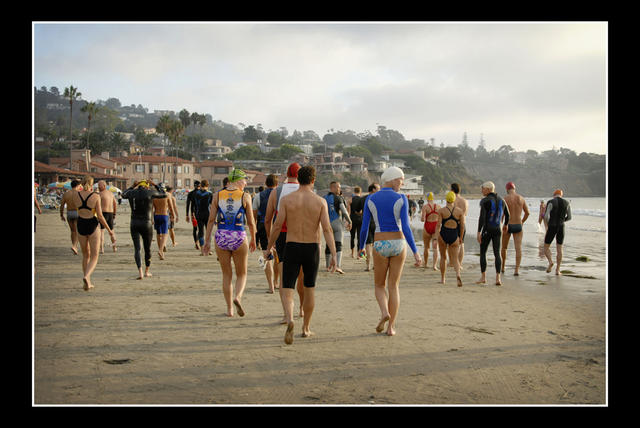

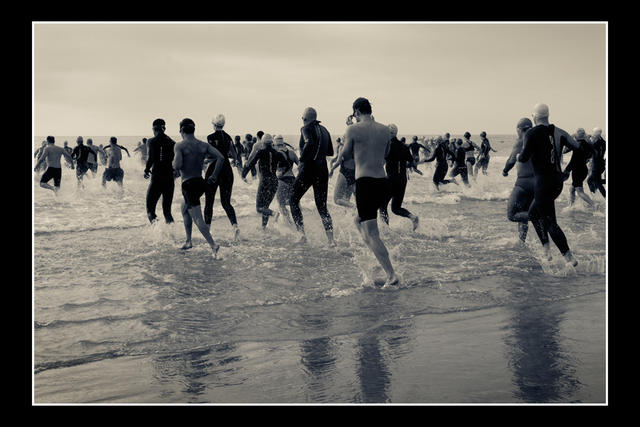
The Truth about NSAIDs, Ice, and other anti-inflammatories
For some of us, popping an aspirin is as common as brushing our teeth. But what are we really doing to our bodies when we treat an ache or a pain with some ibuprofen or break out the ice pack?
I've learned a lot about inflammation in the last few months since I joined the Immunology Department as a postdoc. In addition, our lab studies the connection between inflammation and atherosclerosis (accumulation of plaques in the arteries). Contrary to traditional belief, atherosclerosis is more than just a metabolic disease. It is also a chronic inflammatory disease, similar to arthritis or asthma. But I digress...
First off, what are NSAIDs? They are non-steroidal anti-inflammatory drugs, including aspirin (salicylate), Ibuprofen (Motrin, Advil, etc.), acetaminophen (Tylenol), and COX-2 specific inhibitors, such as Vioxx or Celebrex. Although they all act on the same pathway, each drug has slightly different effects for unclear reasons.
Efficacy of Different NSAIDs:
For instance, in addition to pain-relieving, anti-inflammatory properties, aspirin is also the most potent at preventing clotting, which is why patients are advised not to take it before a surgery. In addition, people suffering from symptoms of a heart attack have been advised to take an aspiring while waiting for the ambulance. The reasoning behind this suggestion is that if the heart attack is being induced by a clot, the aspirin will thin the blood and potentially break up the clot. Acetaminophen is least effective in anti-inflammatory properties but is still effective as an anti-pyrogenic (preventing fever). In addition, acetaminophin is renowned for being gentle on the tummy. Ibuprofen is typically most effective in relieving aches and pains associated with soft tissue injuries and joint pain (overuse injuries from training).
How do NSAIDs work?
Invariably, all these drugs block pain by inhibiting the enzyme COX-2 (cyclooxygenase-2). This enzyme converts arachidonic acid (a type of fatty acid) into prostaglandins. There are several different types of prostaglandins, all of which have important functions in various pathways, such as stimulating cell growth, inhibiting cell death, stimulating the growth of new blood vessels (angiogenesis), recruitment of platelets (clotting), pain, swelling, and inflammation. Because COX-2 is involved in tissue repair and wound healing, studies have been done to investigate whether inhibition of COX-2 activity with NSAIDs might delay healing.
Sidenote--NSAIDs and fever:
Prostaglandins act in many different tissues of the body, including the hypothalamus of the brain, which is where prostaglandins go when they want to signal the brain to induce a fever. That's why we also take NSAIDs when we're sick to reduce a fever. You may have heard the old wive's tale, "Feed a cold, starve a fever," which advocates letting the patient "sweat it out" to allow the immune system to do its thing. Although, the body induces fever when we're sick as an attempt to kill off invading microbes by "nuking" them, the body's own cells don't fare too well if the fever is too high or persists for too long. Our cells may be able to withstand the increased temps better than the bugs but not for long. That's why it's better to control the fever with NSAIDs when you're sick right away. It's better to be safe and make yourself comfortable (and drink lots of fluids!). If the fever doesn't go down or returns when the NSAIDs wear off for more than 24 hours, see a doctor right away to see if you need antibiotics.
"For the most common disorders associated with fever, however, there's no convincing evidence that fever itself hastens recovery from common infections or that it correlates with a better outcome. There's experimental evidence that higher temperatures are harmful to certain bacteria, but medical experts disagree about whether this translates into a role for fever improving our ability to fight infection. In fact, most experts do agree that suppressing fever (for example, with acetaminophen) is not harmful, may be helpful, and they would never suggest trying to raise body temperature when fever is present...Since higher body temperature doesn't contribute to recovery, efforts to raise body temperature during a fever aren't advisable and may even be dangerous. And while one's appetite may be poor when a fever accompanies illness, there's no clear benefit (and there may be harm) to the strategy of trying to "starve a fever.""
"For the most common disorders associated with fever, however, there's no convincing evidence that fever itself hastens recovery from common infections or that it correlates with a better outcome. There's experimental evidence that higher temperatures are harmful to certain bacteria, but medical experts disagree about whether this translates into a role for fever improving our ability to fight infection. In fact, most experts do agree that suppressing fever (for example, with acetaminophen) is not harmful, may be helpful, and they would never suggest trying to raise body temperature when fever is present...Since higher body temperature doesn't contribute to recovery, efforts to raise body temperature during a fever aren't advisable and may even be dangerous. And while one's appetite may be poor when a fever accompanies illness, there's no clear benefit (and there may be harm) to the strategy of trying to "starve a fever.""
Unfortunately, except for the COX-2-specific inhibitors, the other NSAIDs also block COX-1, a closely-related enzyme to COX-1. COX-1 is responsible for making prostaglandins which ultimately results in maintenance of the mucosal lining of the gut. So if COX-1 is inhibited on a chronic basis (e.g. one who pops Advil 2-3x/day), this lining can be worn down, leading to gastric problems including ulcers. (The COX-2 specific inhibitors were designed for people who have chronic pain, such as arthritis, and need to use COX-2 inhibitors on a daily basis, but have sensitive stomachs). COX-1 also stimulates production of a prostaglandin involved in clotting within the bloodstream, which can contribute to heart attack and stroke, especially if individuals are already suffering from atherosclerosis. Inhibiting COX-1 with aspirin, in these instances, can actually help prevent these conditions in afflicted individuals (see my digression on aspirin, above).
NSAIDs and Muscle Injuries:
NSAIDs and Muscle Injuries:
Why am I going into all this? The question of whether to use anti-inflammatories to "treat" overuse injuries has become a popular debate. First, anti-inflammatories will not "treat" or heal an overuse injury. They will reduce swelling and pain. If you've gotten in the habit of popping an Advil to mask the pain of your IT band while you go out for your daily 10 mile run, you may be doing more harm than good. Pain is your body's way of telling you there's something wrong. You need to address it by going to a good sports medicine doc, physcial therapist, or other highly qualified sports health professional, who can evaluate your biomechanics and conformation and put you on a program in which you can allow the injury to heal and then prevent it from happening again. Many people have turned a minor sprain into a tendon rupture from abusing NSAIDs, ignoring the pain, and continuing to run without addressing the underlying problem.
This said, taking an Advil to make yourself more comfortable and relieve pain induced by an injury is perfectly fine, even advisable, and will not delay the healing process. As long as you are taking other measures to allow yourself to heal (e.g. rest, ice, compression, elevation (RICE)), the occasional use of NSAIDs to minimize pain from an injury will not delay healing.
In addition, if you have chronic inflammatory condition, like arthritis or tendonitis, the use of NSAIDs may actually be beneficial. In this instance, your body's immune system has tried (and failed; hey, we're not perfect!) to heal the injury but is now in a vicious, futile cycle of a chronic inflammatory state, which can actually weaken your body overall. The immune system can't be as good as a sentinel at warding off infection when its investing so much energy in inflammation for a chronic injury that's never going to heal.
In addition, if you have chronic inflammatory condition, like arthritis or tendonitis, the use of NSAIDs may actually be beneficial. In this instance, your body's immune system has tried (and failed; hey, we're not perfect!) to heal the injury but is now in a vicious, futile cycle of a chronic inflammatory state, which can actually weaken your body overall. The immune system can't be as good as a sentinel at warding off infection when its investing so much energy in inflammation for a chronic injury that's never going to heal.
Proper use of NSAIDs can might actually help speed recovery. The reasoning is that when we're in less pain, we're more comfortable so we are more relaxed and sleep better, thus speeding the healing process. In addition, recent research has found gentle movement of the injured limb may help speed recovery by increasing blood flow to the area and also preventing muscle atrophy (thus R.I.C.E. has now become M.I.C.E., in which the "rest" has been replaced with "move (gently)).
Ice and Injury:
Along similar lines, use of ice to reduce inflammation directly over the injured area, is also an effective measure of minimizing pain, reducing inflammation, and perhaps preventing onset of muscle trauma, soreness, and injury. Many Olympic and pro athletes, such as Olympic marathoners, Paula Radcliffe and Deena Kastor, swear by "ice baths" and actually lower their entire body into a literal bath of ice after a hard workout. Now that's hard-core! Cold reduces swelling and initially restricts blood flow, providing a natural compress on the microscopic tears in the tissue that are leaking blood into the traumatized area. Shortly, the body will recruit new blood to the cold area that flushes out metabolic wastes and lactic acid - byproducts of heavy muscle activity.
Other informative websites on NSAIDs:
Common Exercise Myths
OTC Pain Medication (Univ of Chicago)
NSAIDs and Musculoskeletal Treatment
NSAIDs and sports injury (Physioroom)
Ice Therapy websites:
Cryotherapy
Ice in Your Bath (Squashsite)
Research articles (NSAIDs and Treatment Injured Muscle):
1. Vignaud A, Cebrian J, Martelly I, Caruelle JP. Effect of anti-inflammatory and antioxidant drugs on the long-term repair of severely injured mouse skeletal muscle. 2005. Exp Physiol. 90(4):487-495.
2. Baldwin Lanier A. Use of nonsteroidal anti-inflammatory drugs following exercise-induced muscle injury. 2003. Sports Med. 33(3):177-185.
3. Dudley GA, Czerkawski J, Meinrod A, Gillis G, Baldwin A, Scarpone M. Efficacy of naproxen sodium for exercise-induced dysfunction muscle injury and soreness. 1997. Clin J Sports Med. 7(1):3-10.
Subscribe to:
Posts (Atom)